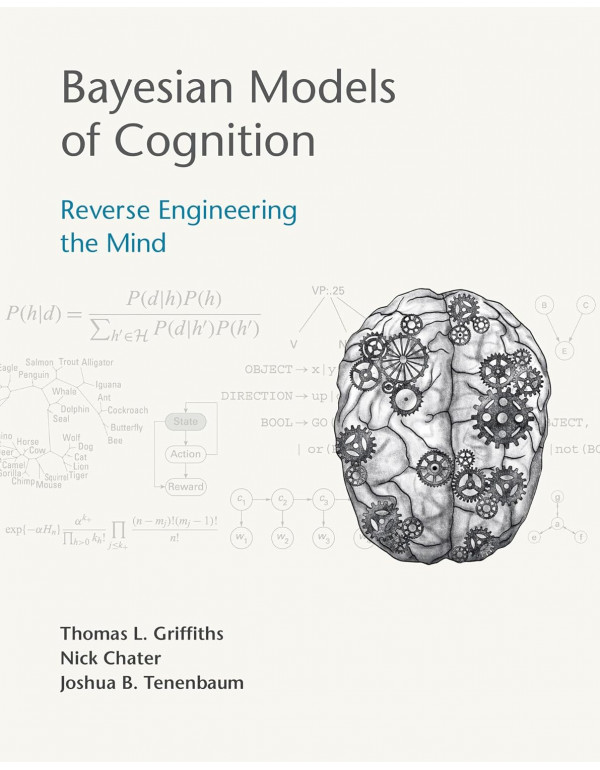
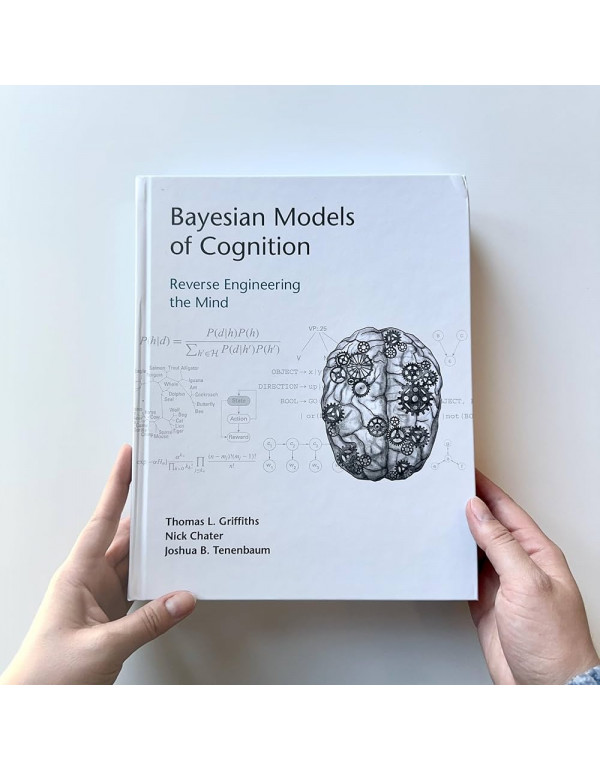
Bayesian Models of Cognition: Reverse Engineering the Mind (Hardcover)
Edited by Thomas L. Griffiths & Nick Chater
Bayesian Models of Cognition: Reverse Engineering the Mind, edited by
Thomas L. Griffiths and Nick Chater, presents cutting-edge
research demonstrating how Bayesian probability theory offers a unified framework for
understanding how the human mind learns, infers, and decides. Bringing together leading voices
in cognitive science, psychology, neuroscience, and AI, the book shows how Bayesian reasoning
helps connect human and machine intelligence.
Product Details
- Title: Bayesian Models of Cognition: Reverse Engineering the Mind
- Editors: Thomas L. Griffiths; Nick Chater
- Publisher: MIT Press
- ISBN-13: 9780262049412
- Format: Hardcover
- Pages: 520+
- Price: $59.99
- Availability: In Stock | Free Worldwide Shipping
Key Features
- Comprehensive synthesis of Bayesian cognitive modeling across perception, learning, and decision-making
- Interdisciplinary contributions spanning cognitive science, psychology, neuroscience, and AI
- Computational reverse engineering approaches that predict and explain human thought and behavior
- Research-grade depth suitable for advanced study and professional reference
- MIT Press publication recognized globally for authoritative cognitive science and AI research
Table of Contents (Highlights)
- Bayesian Approaches to Cognition and the “Bayesian Mind”
- Inference Under Uncertainty and Probabilistic Representation
- Learning, Generalization, and Structure Discovery
- Decision-Making, Utility, and Rational Analysis
- Perception and Visual Cognition Models
- Language, Communication, and Bayesian Pragmatics
- Links to Machine Learning and AI Inference
- Computational Modeling Case Studies and Applications
Bulk, Wholesale & Dropshipping
BooksGoat supplies books in bulk to institutions and resellers and also supports
dropshipping, FBA prep, and 3PL fulfillment. Sell books globally without holding
inventory — we manage sourcing, packing, labeling, and dispatch.
|
|
Overview
An advanced MIT Press research volume on Bayesian models of cognition, explaining how
probabilistic inference can unify accounts of learning, perception, reasoning, and
decision-making. Highly relevant for readers working at the intersection of cognitive science
and modern AI.
Who Should Use This Book?
- Cognitive scientists and experimental psychologists
- Computational neuroscientists and modelers
- AI and machine learning researchers exploring probabilistic inference
- Graduate students in cognitive science, psychology, and AI
- Researchers studying learning, perception, and decision-making under uncertainty
Why Buy from BooksGoat?
- Best Price: $69.99
- Free Worldwide Shipping on all orders
- Authentic Edition sourced from authorized channels
- Reliable fulfillment for individuals and institutions
FAQs
- Is this book a textbook or a research volume?
It is an advanced research anthology featuring chapters by leading scholars in cognitive science and AI.
- Do readers need a strong mathematics background?
Basic familiarity with probability is helpful, but the book emphasizes conceptual understanding over heavy mathematics.
- Is this relevant for AI and machine learning professionals?
Yes, it directly connects Bayesian models of human cognition with modern AI and machine learning inference methods. - ho is the primary audience for this book?
Cognitive scientists, psychologists, neuroscientists, AI researchers, and graduate-level students.
Explore how probabilistic inference can “reverse engineer” human intelligence with
Bayesian Models of Cognition.
|

 4.7 (1) Reviews
 4.8 (5) Reviews